
June 10, 2026 – Just when it seemed like the global equity rally could do no wrong, Japan delivered a stark reality check. On Monday, June 8, the Nikkei 225 index tumbled more than 4% at one point, erasing over ¥48.3 trillion ($335 billion) in market value in a single trading session.
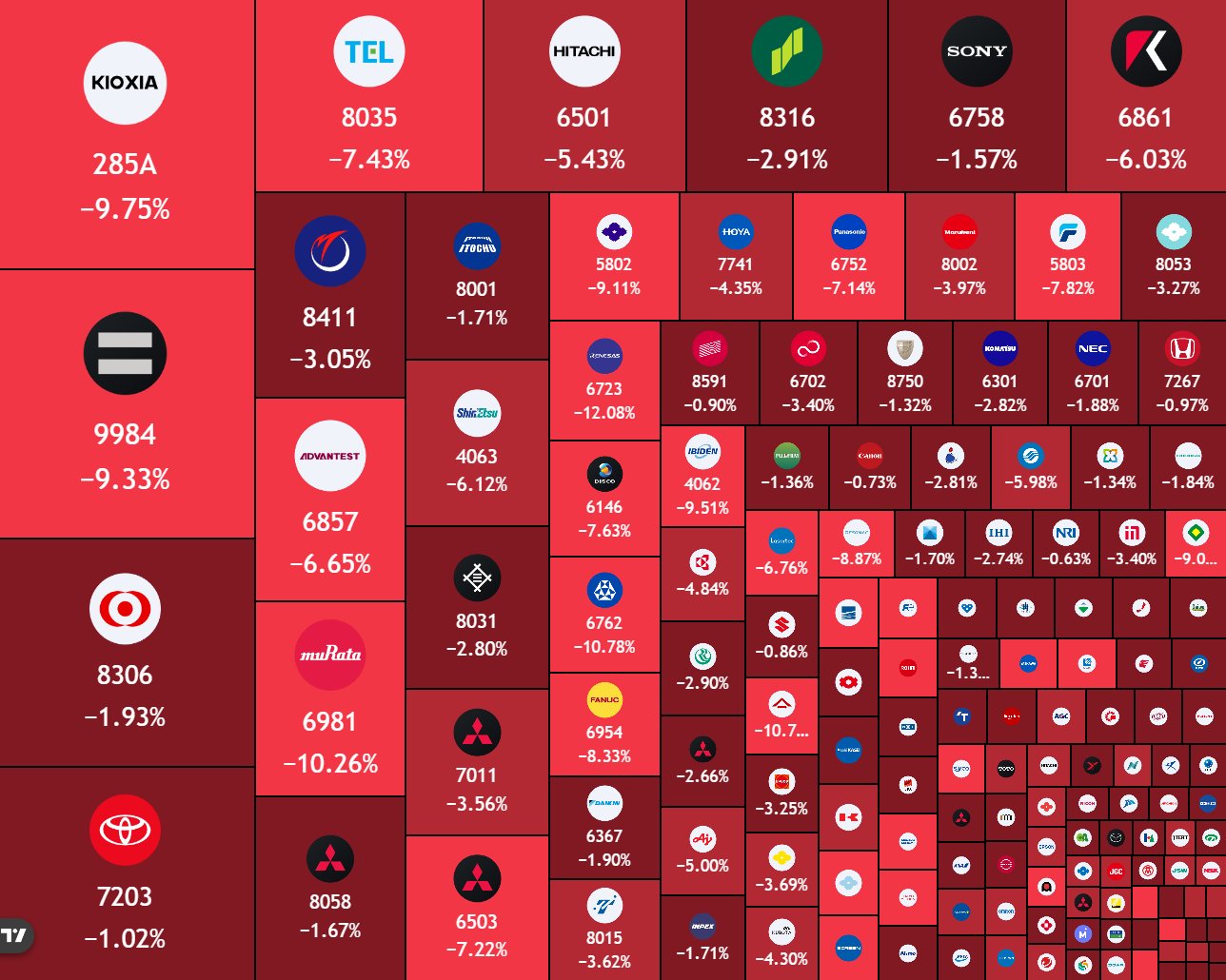
The viral X post from @BullTheoryio captured the moment perfectly: a sea of red on the Japanese market heatmap, with semiconductor and AI-related heavyweights leading the bloodbath.
If you’ve been following the charts, this wasn’t subtle. The benchmark closed down roughly 3.85% at 64,024.60 after shedding more than 2,500 points intraday – one of the largest single-day point drops of the year.
The broader TOPIX index fell about 2.45%. For context, this came after the Nikkei had been riding high, recently topping 68,000 on AI-fueled euphoria just days earlier.
The Heatmap That Told the Story
The now-viral chart shared on X paints a grim picture: a treemap dominated by deep crimson tiles. Kioxia (memory chip giant) plunged -9.75%, Advantest (semiconductor test equipment) dropped -9.33%, Tokyo Electron (TEL) lost -7.43%, and Murata Manufacturing cratered -10.26%. Even household names like Sony, Hitachi, and SoftBank Group took heavy hits, with losses ranging from 1.5% to nearly 6%. Smaller AI-adjacent plays filled the screen in varying shades of red, signaling broad-based profit-taking across the tech ecosystem that had powered Japan’s 2026 rally.
It wasn’t just noise – it was a coordinated unwind in the very sectors that had been the market’s darlings.
What Sparked the Selloff?
Three main catalysts converged on Monday:
- Spillover from Wall Street’s Friday Tech Rout
U.S. markets closed sharply lower after a blockbuster jobs report and cooling AI enthusiasm. Chip stocks like Broadcom and others faced heavy selling amid concerns that valuations had gotten frothy. Japan, with its deep exposure to global semiconductor supply chains, felt the pain immediately. - Strong U.S. Jobs Data Fuels “Higher for Longer” Fed Bets
Unexpectedly robust American employment numbers raised expectations that the Federal Reserve might keep rates elevated longer than hoped. Higher U.S. yields typically pressure risk assets worldwide – and Japan’s export-heavy, tech-driven market is especially sensitive. - Geopolitical Jitters and Oil Prices
Escalating tensions between Iran and Israel pushed oil prices higher. As a massive net importer of energy, Japan feels this sting directly in corporate margins and inflation expectations. The combination of rate fears and energy costs created the perfect storm for risk-off sentiment.
The result? A textbook “risk-off” day in Asia.
Not Just Japan – South Korea Triggers Circuit Breakers
The pain wasn’t isolated. South Korea’s Kospi index plunged over 8%, triggering a rare circuit breaker halt shortly after the open – the third time this year. Samsung Electronics and SK Hynix, two of the world’s biggest memory chip makers, led the rout with double-digit losses at points. The won weakened sharply before rebounding slightly on emergency government intervention.
Taiwan and other Asian tech hubs also felt the heat, underscoring how interconnected the global AI supply chain has become.Is This the End of the AI Boom – or Just a Healthy Correction?Here’s the million-dollar (or ¥48 trillion) question: Is this the beginning of a broader unwind, or simply profit-taking after an extraordinary run?
- Bear case: The AI trade had become extremely concentrated. Valuations in semiconductors and related names stretched to extremes. A “higher for longer” rate environment plus geopolitical uncertainty could prolong the correction.
- Bull case: Many analysts view this as a classic shakeout. Japan’s economy has shown resilience, the Bank of Japan remains accommodative relative to the Fed, and underlying demand for AI infrastructure remains strong. Some traders are already calling Monday a generational buying opportunity in oversold tech names.
Either way, Monday’s move serves as a reminder: even the hottest rallies eventually pause for breath.What Investors Should Watch Next
- U.S. market reaction this week – Will Wall Street stabilize or extend the selloff?
- Oil price trajectory and any de-escalation in the Middle East.
- Bank of Japan policy signals – Any hint of rate hikes could add further pressure.
- Corporate earnings from key Japanese tech exporters in the coming weeks.
Bottom Line
The ¥48 trillion wipeout in Japan wasn’t just another red day – it was a loud warning shot across global markets. The AI supercycle isn’t dead, but the easy money phase may be. For long-term investors, volatility like this creates opportunity; for leveraged players chasing the top, it’s a painful lesson in risk management.
Markets climb a wall of worry… but sometimes they need a breather at the top.
Stay diversified, keep perspective, and remember: corrections are normal – even in bull markets.What do you think – dip-buying time or time to sit on the sidelines? Drop your thoughts below.
This is not financial advice. Always do your own research and consult a professional advisor.
Leave a Reply
You must be logged in to post a comment.