
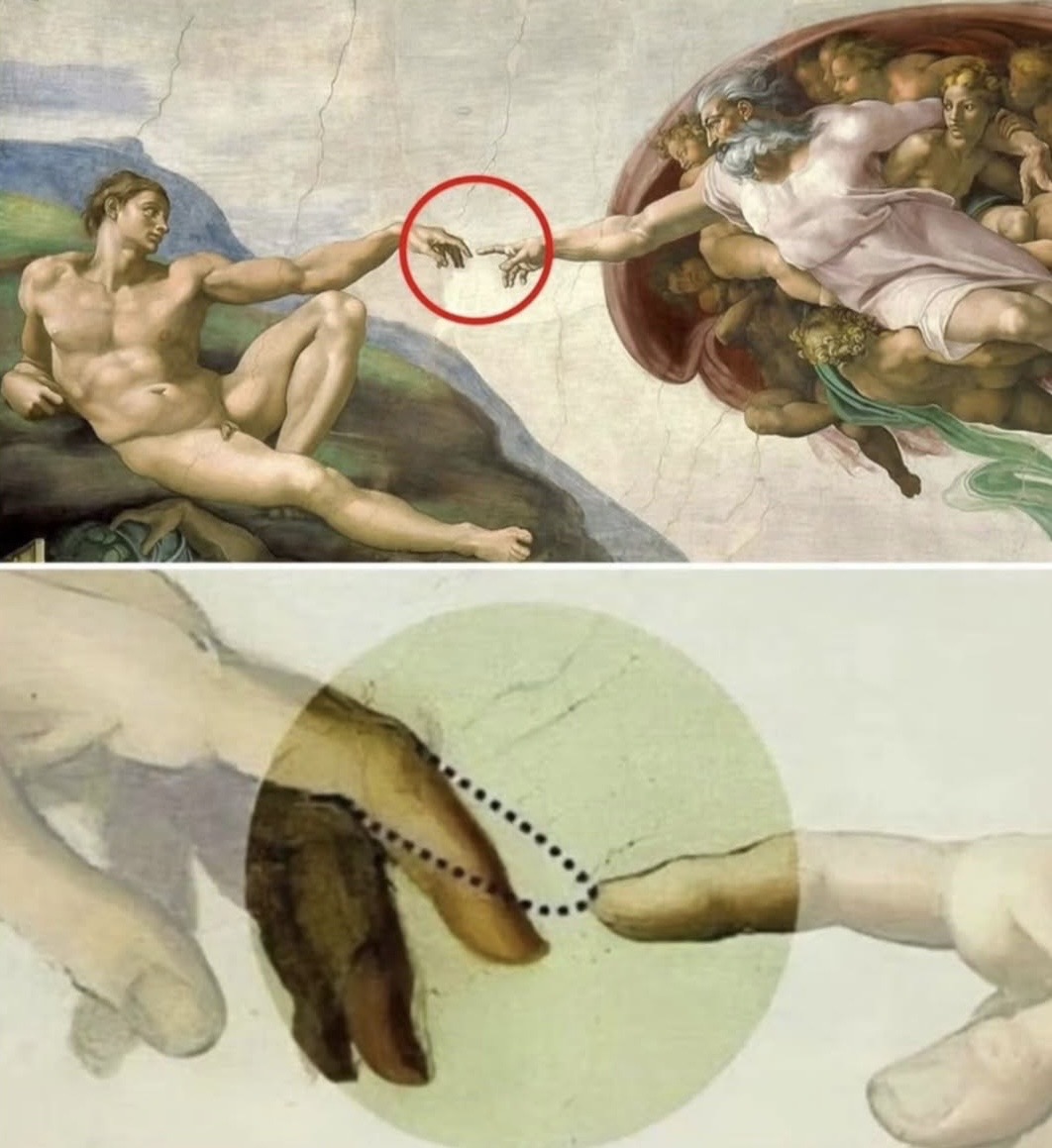
For nearly 500 years, hundreds of millions of people looked at the most famous painting of God ever made, and none of them noticed what was hiding in plain sight.
Then, in 1990, a doctor looked up at the ceiling of the Sistine Chapel and realized that God is wrapped inside a human brain…
The painting is Michelangelo’s Creation of Adam, finished around 1512. You know the image even if you don’t know its name: God reaching out from the heavens, His finger almost touching Adam’s, the spark of life about to leap across the gap.
Coincidence? I don't think so.
— James Lucas (@JamesLucasIT) June 30, 2026
For nearly 500 years, hundreds of millions of people looked at the most famous painting of God ever made, and none of them noticed what was hiding in plain sight.
Then, in 1990, a doctor looked up at the ceiling of the Sistine Chapel and realized… pic.twitter.com/DDtSo4AG1a
But look at the shape around God, the swirling red cloak that holds Him and the angels aloft. For five centuries it was seen as just a billowing robe… but in 1990, a physician named Frank Lynn Meshberger published a paper in the Journal of the American Medical Association arguing that the red shroud is something else entirely: an anatomically precise cross-section of the human brain.
Once you see it, you cannot unsee it.
The outline of the cloak traces the outer curve of the brain. A fold in the fabric forms the Sylvian fissure, the deep groove that separates the brain’s major lobes. The angel curled beneath God is positioned exactly where the brainstem would be, and the green scarf trailing down becomes the vertebral artery. Even the pituitary gland and the optic chiasm, where the nerves from the eyes cross, fall precisely into place.
This was not a man likely to invent such a thing by accident. Michelangelo had spent his youth secretly dissecting human corpses in a monastery in Florence, studying the body from the inside with an obsessiveness that, by one early account, exceeded that of professional anatomists…
So what did he mean by it?
Meshberger argued that the painting has been misnamed. He suggested it should be called not the Creation of Adam, but the Endowment of Adam. In the Bible, God gives Adam life. But in Michelangelo’s fresco, Adam is already alive, his eyes open, his body lifted. What God is reaching across that famous gap to give him is not life. It is intellect. The divine spark of human thought itself, delivered, fittingly, from inside the very organ that produces it.
One of the most looked-at images in the history of the world may contain a message that took half a millennium to be read, hidden by a man who understood both the human body and the human soul better than almost anyone who has ever lived, and who seems to have decided to bury his deepest idea about us where only the most careful eye would ever find it…
Leave a Reply
You must be logged in to post a comment.