
In a major transparency move on April 13, 2026, Director of National Intelligence Tulsi Gabbard released never-before-seen documents exposing what she describes as a coordinated effort by “deep state actors” within the Intelligence Community to manufacture a false narrative. That narrative, according to the declassified materials, was weaponized by House Democrats to impeach President Donald J. Trump in 2019 over his July 25 phone call with Ukrainian President Volodymyr Zelensky.
The release includes previously withheld investigative files from then-Intelligence Community Inspector General (IC IG) Michael Atkinson, along with two closed-door transcripts of his testimony before the House Permanent Select Committee on Intelligence (HPSCI). These transcripts had been locked away and withheld even from the House Judiciary Committee during the impeachment proceedings.
“Deep state actors within the Intelligence Community concocted a false narrative that was used by Congress to usurp the will of the American people and impeach the duly-elected President of the United States.”
The Core Allegations from the Declassified Records
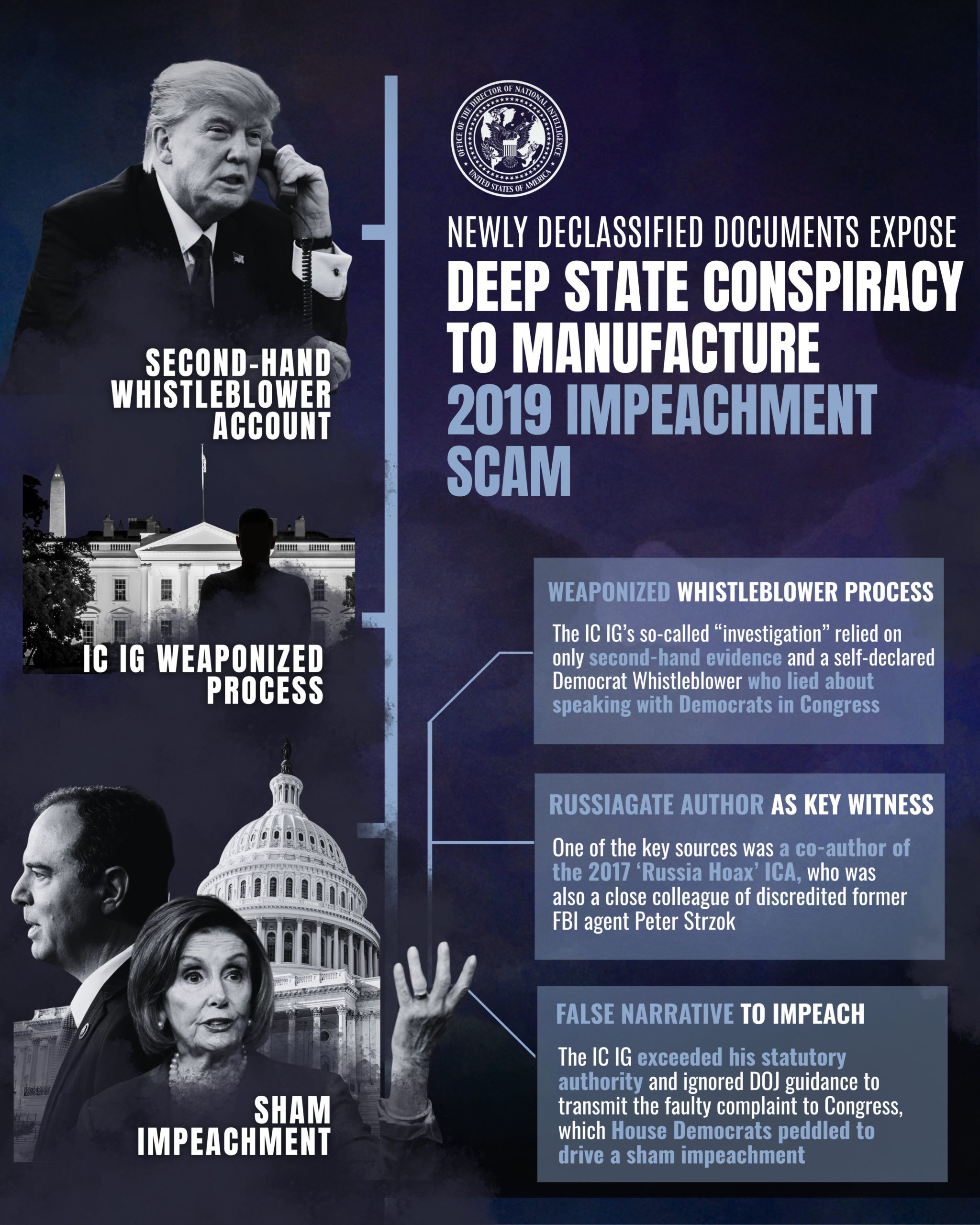
An accompanying ODNI infographic titled “NEWLY DECLASSIFIED DOCUMENTS EXPOSE DEEP STATE CONSPIRACY TO MANUFACTURE 2019 IMPEACHMENT SCAM” lays out the key claims in stark terms:
- Weaponized Whistleblower Process: The IC IG’s “investigation” relied exclusively on second-hand evidence from a self-declared Democrat whistleblower who later admitted he had no direct knowledge of the President’s comments. The whistleblower falsely claimed on his complaint form that he had not spoken with Congress beforehand—records now show he had prior contact with Democratic staff on the House Intelligence Committee.
- Russiagate Author as Key Witness: One of the primary sources backing the complaint was a co-author of the controversial 2017 Intelligence Community Assessment (ICA) on Russian election interference—the same assessment long criticized as the foundation of the “Russia hoax.” This witness was also a close colleague of discredited former FBI agent Peter Strzok.
- False Narrative to Impeach: The IC IG exceeded his statutory authority and ignored explicit guidance from the Department of Justice (DOJ) when he fast-tracked the complaint to Congress. The entire preliminary review involved interviews with just four individuals—none of whom had firsthand knowledge of the Trump-Zelensky conversation.
Supporting documents reveal that the whistleblower’s own supervisor expressed concerns about the rushed nature of the complaint, describing feeling “looped in right at the time of the crash.” One key witness admitted he had to “read between the lines” and only perceived a quid pro quo “in hindsight.”
What Actually Happened in 2019?
For context, the impeachment centered on allegations that Trump pressured Zelensky to investigate Joe and Hunter Biden’s dealings in Ukraine while withholding military aid. House Democrats, led by then-Speaker Nancy Pelosi and Intelligence Committee Chairman Adam Schiff, framed it as an abuse of power and obstruction of Congress.
The whistleblower complaint—filed in August 2019—became the spark. It was treated as an “urgent concern” by IC IG Atkinson despite the second-hand nature of the information. The complaint was transmitted to Congress within days, fueling a rapid impeachment inquiry that culminated in two articles of impeachment passed along party lines in December 2019. The Senate acquitted Trump in February 2020.
What the newly declassified records now suggest is that the process was flawed from the start: politicized actors allegedly bypassed normal safeguards, ignored legal guidance, and relied on biased, indirect sources to build a case that reached Congress and the public.
Why This Release Matters Now
This declassification comes more than six years after the events and fits into a broader pattern of transparency efforts under the current administration. Earlier declassifications by DNI Gabbard have already revisited the 2016 Russia investigation, the 2017 ICA, and related matters.
Critics on the left have dismissed the move as partisan revisionism, pointing to the publicly released rough transcript of the Trump-Zelensky call and testimony from multiple officials who described the aid and investigations as linked. Supporters, however, argue the documents prove the whistleblower process was gamed to manufacture a scandal where none existed under proper intelligence protocols.
Public reaction on X has been fiery. Many users are demanding prosecutions, with comments ranging from “Jail them all” to calls for treason trials. Others remain skeptical, asking when—or if—anyone will actually face consequences.
Restoring Trust or Just Another Chapter?
The 2019 impeachment was the first of two against Trump and remains deeply divisive. Whether these declassified records will shift public opinion or lead to further investigations remains to be seen. What is clear is that the documents raise serious questions about the integrity of the intelligence oversight process and the potential for politicization at the highest levels.
As Gabbard and the ODNI have emphasized, the goal is accountability and restoring public faith in institutions. The full set of supporting documents is now publicly available on the DNI website for anyone to review.
In an era where trust in government is at historic lows, sunlight remains the best disinfectant. Whether this latest release leads to real reform—or simply fuels further polarization—will be one of the defining stories of 2026.
What do you think? Was the 2019 impeachment a legitimate check on power, or the culmination of a manufactured narrative? Share your thoughts in the comments.
All information sourced directly from the official ODNI press release and declassified materials released April 13, 2026.
Newly-declassified records expose how deep state actors within the Intelligence Community concocted a false narrative that Congress used to usurp the will of the American people and impeach duly-elected President @realDonaldTrump in 2019.
— DNI Tulsi Gabbard (@DNIGabbard) April 13, 2026
Today, we reveal the truth 👇… pic.twitter.com/oLXW5nqi2n
Leave a Reply
You must be logged in to post a comment.