
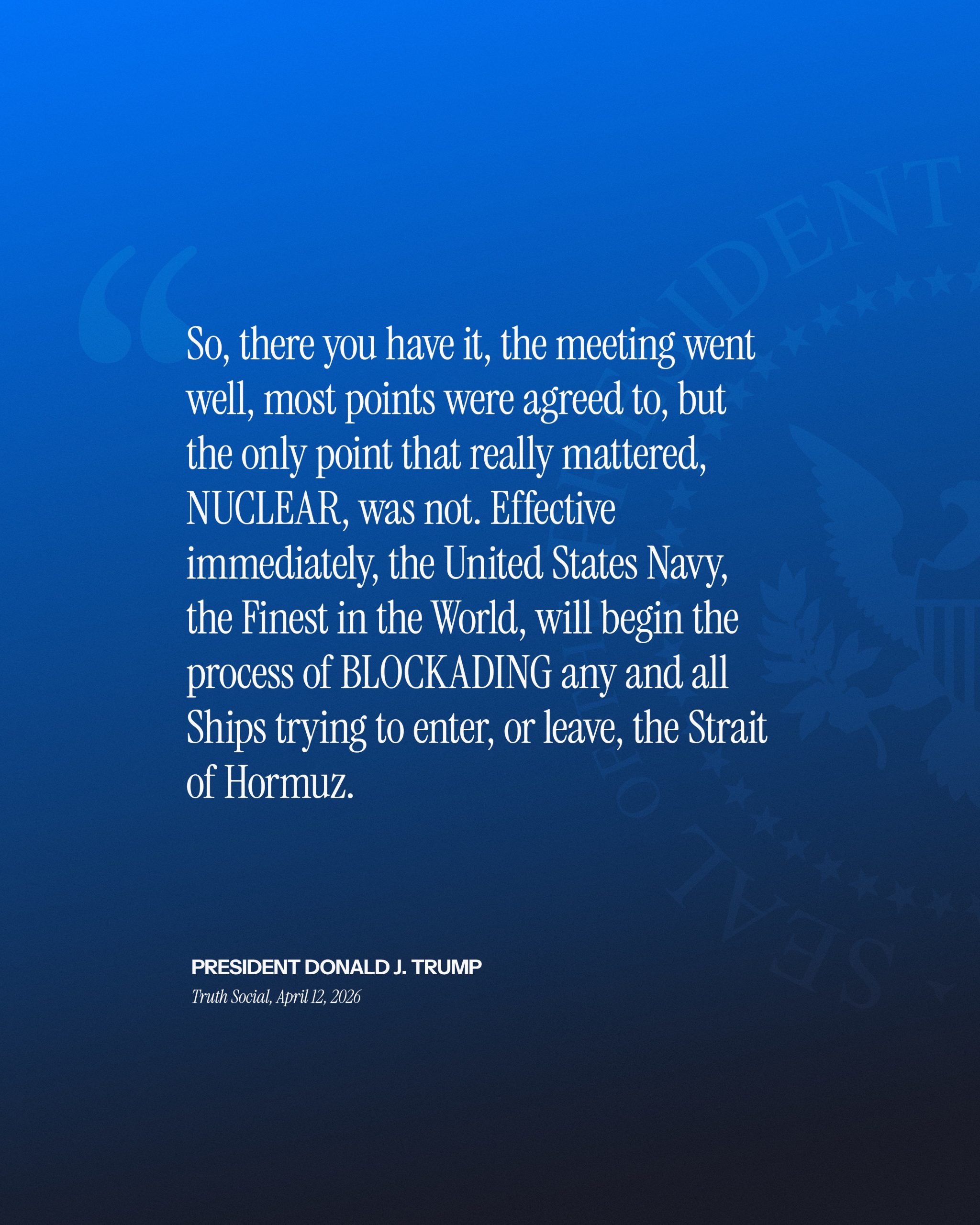
In a dramatic escalation that is already sending shockwaves through global energy markets, the White House has announced that the United States Navy will immediately begin blockading all ships entering or leaving the Strait of Hormuz.
President Trump, quoted directly in the official White House post on X, stated that the blockade is a direct consequence of Iran’s failure to reopen the vital waterway as it had promised. The move comes just days after extended U.S.-Iran peace talks in Islamabad collapsed over disagreements regarding Iran’s nuclear program.
What Led to This Moment?
The current crisis is the latest chapter in a rapidly intensifying standoff. Only weeks ago, the United States concluded Operation Epic Fury — a 38-day military campaign that severely degraded Iran’s naval, air, and missile capabilities. U.S. forces effectively neutralized much of Iran’s ability to project power in the Persian Gulf.
Following the operation, Tehran had reportedly agreed to reopen the Strait of Hormuz to international shipping. Yet that commitment was never honored. With peace negotiations in Pakistan breaking down and Iran continuing to restrict access to the waterway, the Trump administration has shifted from diplomacy to decisive naval action.
Why the Strait of Hormuz Matters
The Strait of Hormuz is one of the world’s most critical chokepoints. Roughly one-fifth of global oil shipments — approximately 21 million barrels per day — pass through this narrow passage between the Persian Gulf and the Gulf of Oman. It serves as the primary export route for oil from Saudi Arabia, Iraq, the UAE, Kuwait, and Iran itself.
Any sustained disruption here doesn’t just affect regional players. It ripples instantly into global supply chains, energy prices, and inflation worldwide. Analysts are already warning of sharp spikes in crude oil futures, with some early trading indicating potential jumps of $10–20 per barrel in the coming days.
Immediate and Long-Term Implications

For Energy Markets: Expect volatility. Refiners, airlines, and shipping companies are scrambling to assess exposure. Offshore energy investors may see both risk and opportunity — higher oil prices typically boost revenues for producers, but prolonged instability can also raise insurance and operational costs for assets in the region.
For Global Trade: Tankers, container ships, and LNG carriers will now face U.S. naval interdiction. Alternative routes around Africa or through pipelines add significant time and expense, further pressuring already strained supply chains.
Geopolitical Fallout: The blockade raises the stakes for every nation dependent on Gulf oil. China, India, Japan, and Europe — all major importers — will be watching closely. Diplomatic efforts are likely to intensify, but the military reality on the water has now changed.
Investment Lens (Especially Relevant for Offshore Strategies):
- Oil & Energy Sector: Near-term winners could include U.S. shale producers, Gulf of Mexico operators, and select offshore drillers less exposed to the Gulf region.
- Defense & Maritime Security: Companies involved in naval logistics, private maritime security, and insurance may see increased demand.
- Currency & Commodities: The U.S. dollar often strengthens in such crises, while gold and other safe-haven assets typically rally.
- Offshore Investors: Diversification remains key. Positions in non-Gulf energy assets, alternative shipping routes (such as expanded Panama or Arctic passages), and inflation-hedged portfolios deserve fresh review.
What to Watch Next
The coming hours and days will be critical. Will Iran attempt to challenge the blockade? How quickly will other nations respond diplomatically or economically? And most importantly for markets: how long does the U.S. intend to maintain this naval presence?
The White House has framed the action as necessary enforcement after broken promises, but the global economy is now firmly in the crosshairs of this confrontation.
For those with international portfolios, offshore holdings, or exposure to energy and commodities, this is not a moment to sit idle. The Strait of Hormuz has once again reminded the world how quickly geopolitics can reshape financial realities.
Stay tuned — developments are moving fast. I’ll continue monitoring and updating as more information emerges from Washington, Tehran, and the markets.
"Effective immediately, the United States Navy, the Finest in the World, will begin the process of BLOCKADING any and all Ships trying to enter, or leave, the Strait of Hormuz." – President Donald J. Trump pic.twitter.com/JInBTLyu2s
— The White House (@WhiteHouse) April 12, 2026
Leave a Reply
You must be logged in to post a comment.