
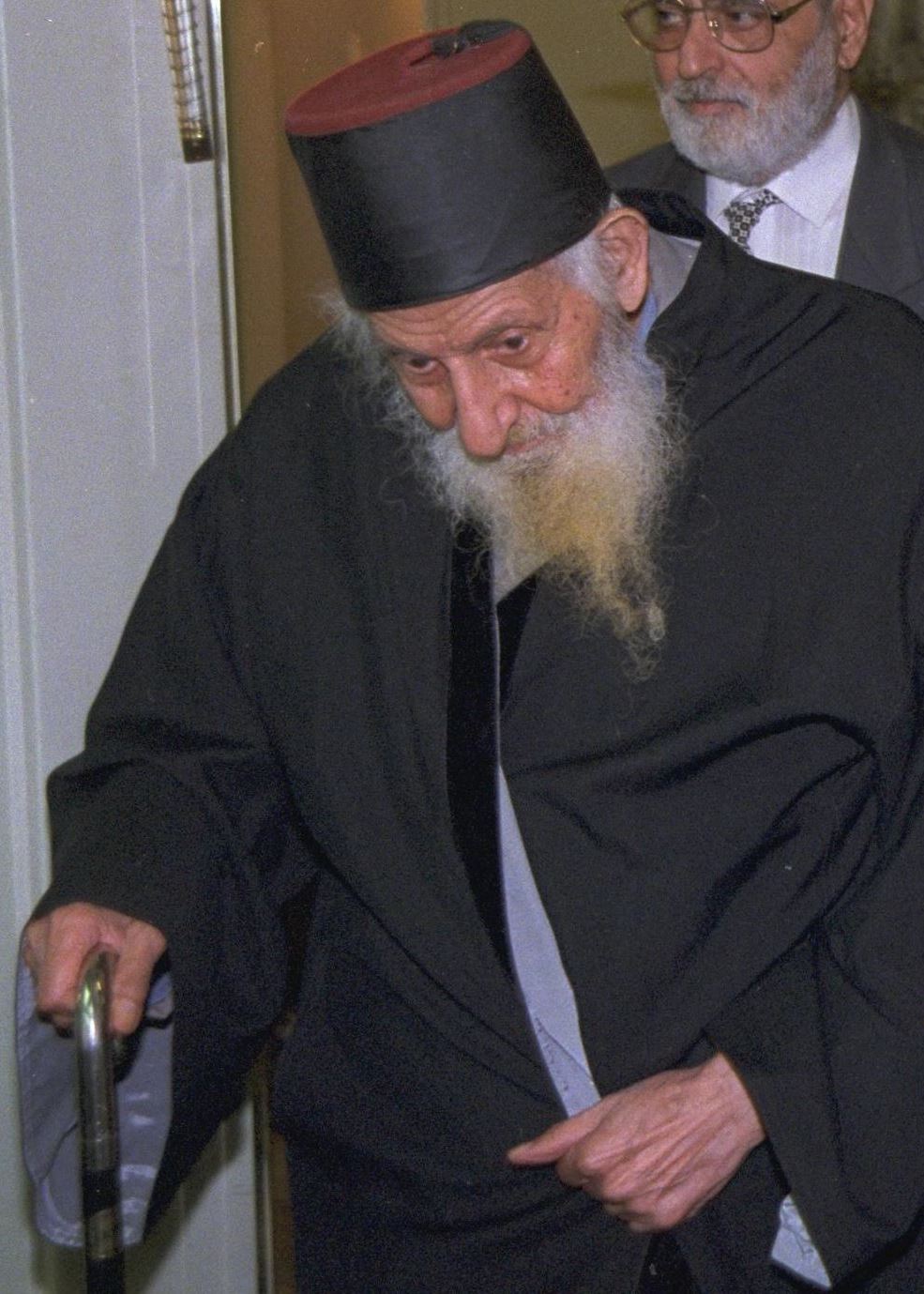
Yitzhak Kaduri (c. 1898–January 28, 2006) was one of the most prominent Haredi rabbis and kabbalists of the modern era, particularly among Sephardi and Mizrahi communities. Born in Baghdad (then part of the Ottoman Empire), he studied Kabbalah from a young age, including under leading figures such as Rabbi Yosef Hayyim (the Ben Ish Chai). He immigrated to British Mandate Palestine in 1923, studied at institutions including Porat Yosef Yeshiva in Jerusalem’s Old City, and developed a reputation for extraordinary memory—reportedly knowing the Talmud and major kabbalistic works by heart. He lived a life of relative simplicity and poverty, practiced the kavanot of the Rashash, prepared amulets, and in his later years was regarded as the senior kabbalist in Israel. He published no books during his lifetime and restricted advanced Kabbalah study. His funeral in Jerusalem drew an estimated 200,000 or more people, one of the largest in modern Israeli history.
In his final years, Kaduri spoke of the imminent arrival of the Jewish Messiah (Mashiach). He stated that he expected the Messiah soon and that he had met him roughly a year earlier. Some accounts, including from close followers, place a reported vision or encounter on 9 Cheshvan 5764 (November 4, 2003). He also reportedly linked the Messiah’s public appearance to events surrounding Ariel Sharon. On Yom Kippur and in other remarks, he discussed recognizing the Messiah and hinted that clues might be found in his own recent words. These statements aligned with blessings he had received decades earlier from figures including the Ben Ish Chai and the Lubavitcher Rebbe, who had expressed the hope that he would live to see the Redeemer.
The Alleged Note
After Kaduri’s death, claims circulated that he had left a sealed handwritten note with instructions that it not be opened until one year later. When the period elapsed, the note was said to have been opened, revealing the Hebrew phrase:

ירים העם ויוכיח שדברו ותורתו עומדים
(Yarim ha-am veyokhiakh shedvaro vetorato omdim)
Common translations include “he will raise the people and confirm that his word and law are standing” or, as rendered by Rabbi Tovia Singer, “The nation will be raised up and it will become known that His word and His Torah stand.” Taking the first letter of each word produces the acrostic יהושוע (Yehoshua), a name meaning “God is salvation.” Purported fuller versions of the note add framing language such as “Regarding the acronym of the Messiah” and a signature dated to the month of mercy (Elul 5765 / roughly September 2005), signed “Yitzhak Kaduri.”
Some Christian and Messianic missionary groups have argued that this points to Jesus. They note that Yehoshua (Joshua) and Yeshua (the Hebrew form of Jesus) share the same root related to salvation, and that biblical texts sometimes use variant forms of the name for the same individuals (e.g., the high priest Yehoshua/Yeshua). They treat the note as evidence that a leading Orthodox kabbalist privately identified Jesus as the Messiah.
Responses and Disputes
Orthodox Jewish responses, particularly from Rabbi Tovia Singer of Outreach Judaism, reject this reading. Singer confirmed that the acrostic does spell Yehoshua—the name of Joshua ben Nun, Moses’ successor and the central figure of the Book of Joshua—not Yeshua, the name used for Jesus of Nazareth. He translated the sentence as affirming that the nation will be elevated and that God’s word and Torah will be shown to stand. The note, on this reading, does not declare “Jesus is the Messiah”; it uses a classic Jewish acrostic technique (common in the Tanakh and later Jewish writing) to embed the name of the biblical Joshua while describing the expected redemptive role of the Messiah in upholding Torah.
Singer and others have also questioned the note’s authenticity. Singer stated that family members he spoke with knew nothing of such a document and regarded it as a forgery. Kaduri’s son, Rabbi David Kaduri, and various close disciples have said the note is not genuine. They noted that around the alleged writing date (Elul 5765), Kaduri’s physical condition made handwriting a substantial note difficult or impossible. The note’s appearance on certain websites (including, briefly, materials associated with Kaduri’s circle) and subsequent removal or disavowal fueled further controversy. Mainstream Haredi and kabbalistic institutions have not accepted the Christian interpretation; Kaduri himself was known as an opponent of missionary activity directed at Jews.
Even if one assumes the note is authentic, the textual content does not explicitly name Jesus or adopt Christian claims. Yehoshua is a well-attested biblical name for Joshua ben Nun; the contraction Yeshua is the form associated with Jesus. Jewish tradition does not identify the Messiah with the historical Jesus of Nazareth, and the note’s emphasis on the Torah standing is consistent with traditional Jewish expectations of the Messiah rather than with supersessionist readings.
Context and Legacy
The episode illustrates how messianic speculation, kabbalistic interest in names and acronyms, and posthumous claims can generate lasting controversy. Kaduri’s broader reputation rested on his scholarship, piety, memory, and role as a communal mystic rather than on any single cryptic document. Claims linking him to Jesus as Messiah have circulated primarily in missionary and Messianic literature (including books and videos by authors such as Carl Gallups) and have been contested by those closest to Kaduri and by counter-missionary educators. The note’s disputed status, the precise name Yehoshua rather than Yeshua, and the sentence’s affirmation of Torah remain central points in the debate.
In short, the documented record shows a revered kabbalist who spoke of meeting the Messiah and of his near arrival. The attributed note produces the name Yehoshua via acrostic and describes the nation being raised with God’s word and Torah enduring. Whether the note is authentic remains contested by family and close associates, and the leap from Yehoshua (Joshua) to Jesus rests on interpretive choices rather than the plain wording of the text.
Leave a Reply
You must be logged in to post a comment.