
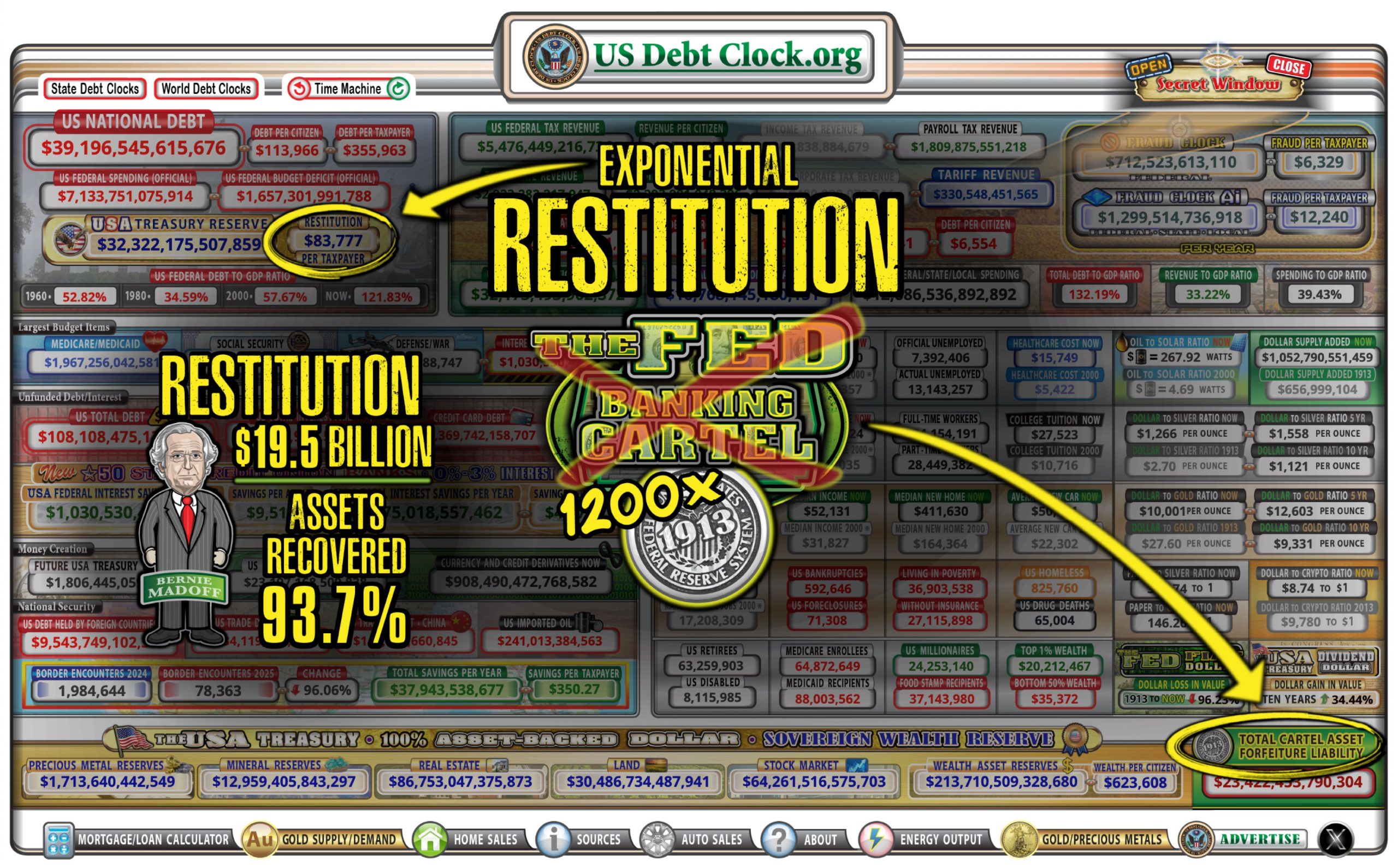
Walk into any alternative finance corner of the internet right now, and you’ll find a viral thesis picking up serious steam: The United States is undergoing a real-time gold revaluation.
The theory is compelling, backed by real-time numbers from the U.S. Debt Clock and fueled by a historic precedent from 1934. It suggests that Washington has a hidden escape hatch to wipe out its staggering national debt—now surging past $39 trillion—without needing a bitter battle in Congress or a traditional hyperinflationary printing spree.
But how much of this theory is grounded in actual law, and how much is just financial fan fiction? Let’s break down the mechanics behind the “Gold Reset” theory.
1. The Debt Clock Divergence: $42 vs. $10,000+
The core spark for this theory lies in a massive accounting quirk on the U.S. Treasury’s balance sheet.
Right now, the U.S. government holds roughly 8,133 metric tons of physical gold (the largest official reserve in the world). But if you look at the official ledger, that gold is valued at a statutory price of just $42.22 per ounce—a fixed price tag slapped on it by Congress back in 1973 and never updated. At $42.22/oz, America’s gold is worth a measly $11 billion on paper.
However, internet sleuths point out that if you look at the U.S. Debt Clock, the real-time “Dollar-to-Gold Ratio” tells a completely different story.
+------------------------------------------------------------+
|  STATUTORY GOLD PRICE (1973 Ledger):       $42.22 / oz     |
|  CURRENT MARKET GOLD PRICE:                ~$2,400+ / oz   |
|  DEBT CLOCK DOLLAR-TO-GOLD RATIO:         $10,000+ / oz    |
+------------------------------------------------------------+
The Debt Clock calculates what the price of gold would be if the paper money supply (M2) or the entire national debt were strictly divided by America’s physical gold reserves. Seeing that number tick upward past $10,000 has led many to believe a real-time adjustment is already taking place behind the scenes to bring the dollar’s true value into perspective.
2. The 1934 Escape Hatch: Presidential Authority
The most fascinating part of the video’s claim isn’t just the math—it’s the legal framework. The video points out that the President of the United States might already possess the unilateral authority to revalue gold without waiting for Congress, thanks to a 92-year-old law: The Gold Reserve Act of 1934.
Historically, this has already happened once:
Executive Order 6102
April 1933
President Franklin D. Roosevelt outlaws the private hoarding of gold coin, bullion, and certificates, forcing Americans to sell their gold to the Federal Reserve at $20.67 per ounce.
Gold Reserve Act of 1934
January 1934
Title to all monetary gold is officially transferred from the Federal Reserve to the U.S. Treasury. Private ownership of gold remains banned.
The $35 Revaluation
February 1934
Using the authority granted by the Act, FDR immediately raises the official price of gold from $20.67 to $35.00 per ounce. This overnight 69% revaluation devalues the dollar, boosts inflation out of a deflationary spiral, and creates instant paper profits for the Treasury.
The video’s central argument is that the statutory mechanics of the 1934 Act are still intact. If a modern President chose to invoke this authority to adjust the official valuation from $42.22 to market rates—or even up to a debt-backed rate of $10,000—it would trigger a massive monetary reset.
It's ALREADY HAPPENING. pic.twitter.com/gVb24GbcWj
— Doug 🇦🇺 (@Jaxxrad) June 1, 2026
3. The Accounting Magic: How It Works
If the government decided to execute this reset, how does it actually wipe away debt? The video lays out a multi-step accounting loop between the Treasury and the Fed that bypasses the taxpayer entirely:
- Step 1: The Revaluation. The President orders the Treasury to update the official statutory price of its 261 million ounces of gold from $42.22 to a modern rate (e.g., $5,000 or $10,000/oz).
- Step 2: Creating “Profit.” At $5,000 an ounce, the Treasury’s gold holdings instantly jump from an $11 billion valuation to over $1.3 trillion. At $10,000 an ounce, it pushes past $2.6 trillion. This creates an immediate, massive paper profit on the Treasury’s balance sheet.
- Step 3: Issuing Gold Certificates. The Treasury prints new “Gold Certificates” representing this newfound valuation increase.
- Step 4: The Fed Exchange. The Treasury deposits these new gold certificates at the Federal Reserve. In exchange, the Fed credits the Treasury’s general account with newly minted digital dollars.
- Step 5: Erasing the Debt. The Treasury uses those hundreds of billions (or trillions) in its account to buy back and retire outstanding U.S. government bonds, instantly shrinking the national debt.
The Reality Check: While major investment banks like Société Générale have published notes exploring this exact thought experiment as a way for Washington to “improve fiscal optics,” mainstream economists warn it would signal supreme systemic stress. Revaluing gold to erase debt is essentially a backdoor devaluation of the U.S. dollar, which could damage its status as the global reserve currency.
The Takeaway
The idea that a gold revaluation is happening “in real-time” because of ticking numbers on a public debt clock is a misunderstanding of how the clock calculates its macroeconomic ratios. However, the video’s underlying legal and historical breakdown is entirely accurate. The mechanism exists, the history is real, and as America’s interest payments on its debt approach $1 trillion annually, the 1934 escape hatch remains one of the strangest “hiding in plain sight” tools in the history of global finance.
For a deeper look into how this historical mechanism works and the financial analysts debating whether the U.S. government would ever use it, check out The Case for $15,000 Gold: Could It Actually Happen?. This video breaks down the 1934 historical precedent, the Federal Reserve’s hidden accounting tools, and how a modern gold macro-reset would impact everyday savings.
Leave a Reply
You must be logged in to post a comment.