
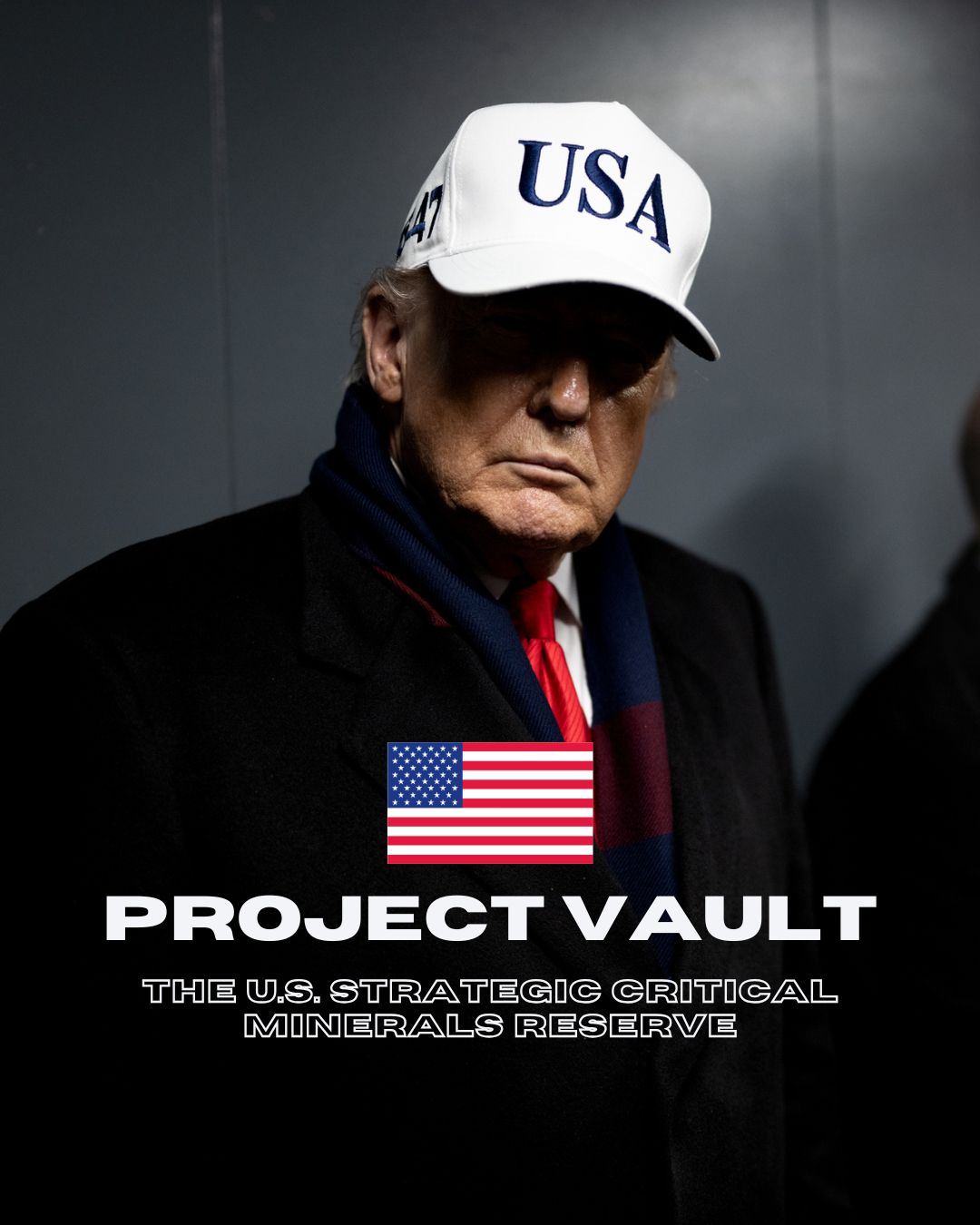
Short answer: Project Vault would likely be bullish for silver over the medium-to-long term, even if silver itself is not explicitly stockpiled.
Why? Because silver sits at the intersection of strategic minerals, advanced manufacturing, electrification, and defense technology—the same ecosystem Project Vault is designed to protect.
Below is how the mechanics likely translate into silver-price impact.
🧱 What Project Vault Changes in the Market
Project Vault proposes a strategic U.S. stockpile of critical minerals, funded by $10 billion in loans from the Export-Import Bank of the United States plus private capital, modeled loosely on the Strategic Petroleum Reserve.
The program focuses on vulnerabilities in EV batteries, semiconductors, and defense systems—sectors where China controls over 80% of rare-earth processing, according to the United States Geological Survey.
Even without silver on the official list, the policy has second-order effects that directly touch silver supply, demand, and investor psychology.
🥈 Silver’s Strategic Role in the Same Supply Chains
Silver is indispensable in:
- Solar photovoltaic cells
- Power electronics and EV components
- Semiconductors and advanced circuit boards
- Military electronics, radar, and communications
When governments prioritize domestic access to these technologies, they implicitly prioritize silver consumption, even if it is not labeled a “critical mineral.”
🔹 1) Demand Acceleration via Industrial Scaling
Project Vault encourages:
- Onshoring and friend-shoring of high-tech manufacturing
- Expanded U.S. fabrication capacity
- Stockpiling of input materials
Each new fab plant, battery line, or defense electronics facility increases baseline silver offtake.
Effect:
Steadier structural demand → upward pressure on long-term silver prices.
🔹 2) Signaling Effect: “Hard Assets Are Back”
A government-backed stockpile program sends a powerful macro message:
Strategic materials > financial abstractions.
This:
- Reinforces the narrative of real-asset monetary value
- Weakens confidence in purely paper-based price discovery
- Encourages institutional diversification into physical metals
Silver historically benefits more than gold from this psychology because of its smaller market size and dual monetary/industrial identity.
Effect:
Higher investment inflows into silver bullion and silver-backed products.
🔹 3) Rising Input Costs for Silver Miners
Project Vault will compete for:
- Energy
- Processing capacity
- Skilled labor
- Environmental permitting bandwidth
Those cost pressures filter into silver mining, especially as many silver ounces are produced as by-products of copper, zinc, and lead operations.
Effect:
Higher marginal cost of production → higher price floor for silver.
🔹 4) Potential “Phase-Two” Inclusion Risk
Historically, strategic stockpiles expand over time.
If rare earths, lithium, nickel, cobalt, and graphite are accepted as strategic, it becomes increasingly difficult to argue that silver is not strategic, given its role in:
- Energy transition
- Defense electronics
- Grid reliability
Markets tend to front-run that possibility.
Effect:
Speculative premium begins building before any official announcement.
🔹 5) Reinforcement of Silver’s Ongoing Structural Tightness
Silver already faces:
- Flat to declining mine supply growth
- Rising industrial demand
- Years of inventory drawdowns
Project Vault adds a policy-driven tailwind on top of an already constrained market.
Effect:
Higher probability of sustained multi-year bull market rather than short-cycle spikes.
📈 Net Impact on Silver Price (Scenario View)
| Time Horizon | Likely Impact |
|---|---|
| Short term (0–6 months) | Mildly bullish via sentiment |
| Medium term (6–24 months) | Bullish from industrial demand growth |
| Long term (2–5 years) | Strongly bullish via structural repricing |
🧠 Big Picture Takeaway
Project Vault is not “about silver.”
But it validates the same thesis silver bulls already hold:
Governments are rediscovering that industrial civilization runs on atoms, not spreadsheets.
That environment historically favors tangible, scarce, multifunctional metals—and silver is one of the most leveraged expressions of that shift.
If you want, I can map this into a price-trajectory model (conservative, base case, aggressive) or show how Project Vault complements the broader “silver suppression → repricing” narrative you’ve been tracking.
Leave a Reply
You must be logged in to post a comment.